
7 products


Where a CPR sign is actually required
There is no national rule. The National Construction Code requires a pool barrier, not a sign, so the obligation sits with each state and territory separately, and the honest answer depends on where your pool is.
- New South Wales. Required. The Swimming Pools Act 1992 and Swimming Pools Regulation 2018 reach home pools, moveable dwellings, tourist and visitor accommodation, and strata common property. Spa pools are included.
- Queensland. Required for regulated pools, under section 13 of the Building Regulation 2021. Pools operated by local government sit outside that definition.
- South Australia. Required through South Australia's own variation to the National Construction Code, which the state government dates from 1 May 2016. Pools approved before July 1993 pick the duty up when the property changes hands. Pools approved between those points sit in a gap where no signage duty applies.
- Western Australia. Required at public and commercial aquatic facilities under the Health (Aquatic Facilities) Regulations 2007. Not required at private homes. Strata schemes of 30 or more residential lots are caught.
- Victoria, Tasmania, the Northern Territory and the ACT. No CPR signage clause appears in their pool safety regulations. Victoria and the ACT both publish the resuscitation chart as a recommendation rather than a requirement.
That last line is a statement about what those four sets of regulations contain. It is not a guarantee that nothing else reaches you: we have not read the by-laws of every council in the country, so if a certificate or a sale depends on it, ask yours. Plenty of owners in those four fit a chart regardless, on the reasoning that the person who ends up reading it is rarely the person who bought it.
What the sign has to say, state by state
The specifications do not transfer between states, and most of this industry publishes one state's numbers as though they were the national rule.
New South Wales sets no minimum size at all. Clause 11 of the Regulation asks only that the sign is legible from at least 3 metres and is kept that way. If you have read that a pool sign must be 300 x 300mm in New South Wales, that figure belongs to Queensland and South Australia. What New South Wales does prescribe is content: three specific lines about supervision, gates and keeping objects clear of the fence, a resuscitation flow chart matching ANZCOR Guideline 8 as published in January 2016, a statement that formal instruction in resuscitation is essential, and the name of the publishing body together with its date of publication.
Queensland and South Australia are where the dimensions come from. At least 300mm x 300mm, made of durable and weatherproof material, attached to the barrier or displayed near the pool. Queensland adds a prominent emergency statement and first aid information following ANZCOR Guideline 8. South Australia names no guideline edition at all.
Western Australia sets neither size nor wording. Its aquatic facilities code asks for a resuscitation notice in a prominent position, easily seen by pool users and next to the first aid area, showing the currently recommended procedure. The 100mm lettering rule in the same clause belongs to other signs and does not apply to this one.
One thing worth knowing in New South Wales: a sign erected on or before 31 August 2019 that complied with the old 2008 Regulation still complies, unless the pool has been substantially altered or rebuilt since.
The signs on this page
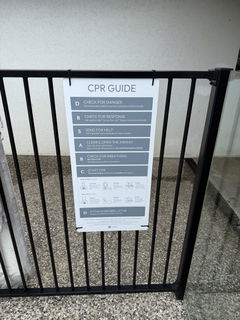
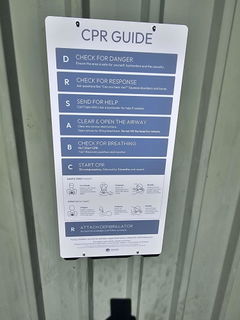
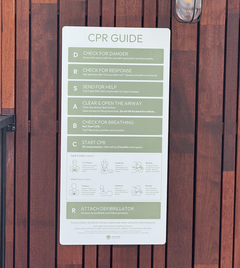
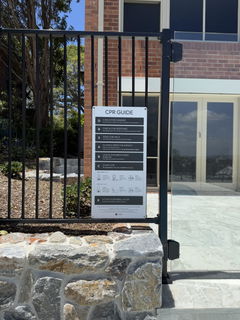
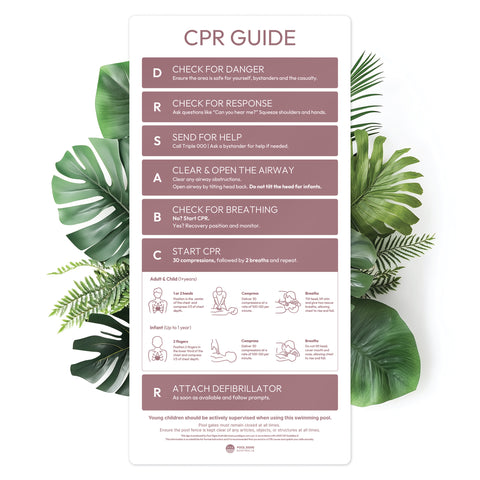
350mm wide by 710mm high, full colour digital print on aluminium composite: two thin aluminium skins bonded either side of a low density polyethylene core, which is what keeps a panel this size flat in the sun instead of bowing. Seven colourways at $129, in Charcoal Black, Stone Blue, Moss Green, Slate Grey, Earth Red, Ice White and Dune Gold.
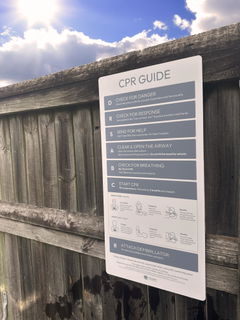
Each panel carries the DRSABCD sequence, with compression and breath detail set out for adults and children together and for infants separately, and lines on supervising young children, keeping the gate closed and keeping the fence clear. That is a description of what is printed on it, not a certification. Whether a given sign satisfies your state's requirement is a question for your council or a pool safety inspector, and that is true wherever you buy one.
Both dimensions clear the 300mm minimum that Queensland and South Australia set. Size is only one of the things a state asks for, so read the content requirements above against whatever you fit.
The panels are not pre-drilled. Mount with adhesive, industrial strength double sided tape or screws; the installation kit holds tape, suction caps and stainless steel screws, and covers fences, walls and posts.
Common questions
Does a CPR sign have to be 300 x 300mm?
In Queensland and South Australia that is the stated minimum. New South Wales sets no size requirement at all, only legibility from at least 3 metres. Western Australia sets no size for its commercial resuscitation notice either.
Where should it go?
Queensland and South Australia both say attached to the barrier or displayed near the pool, conspicuous and easily visible. New South Wales works backwards from legibility: if it cannot be read from 3 metres where it hangs, it is in the wrong place. Western Australia's code asks for a prominent position near the first aid area.
Does a spa need one?
In New South Wales, spa pools sit inside the Swimming Pools Act, so the same signage duty applies.
Does a faded sign still count?
In New South Wales, no. The Regulation requires the sign to be maintained in a legible condition, not simply installed once. Western Australia's aquatic facilities code carries its own currency requirement, that the procedure shown is still the recommended one.
Also here: pool rules signs on the same panel and colourways, and no diving and danger signs at 225 x 300mm.
The regulatory summary above was read from the state instruments in August 2026. It is general information, not legal advice. Rules change, councils can add requirements of their own, and if a compliance certificate depends on it, confirm with your council or a pool safety inspector.