

Swimming pools are a valued feature of Australian homes, apartments and recreational facilities. Along with the enjoyment they provide comes a responsibility to maintain safe conditions for everyone who uses them. While fencing and gates are the most visible safety requirements, signage also plays an important role.
Pool rule signs help communicate clear expectations for behaviour around the pool. They reduce the risk of accidents, guide visitors who may not be familiar with the space and support overall compliance with safety standards.
Understanding the role of pool rule signs and how they fit within the broader framework of pool safety sign Australia requirements helps pool owners and facility managers avoid confusion, improve safety and pass inspections with confidence.
Many pool owners assume that installing a CPR sign is the only signage requirement. While CPR charts are often mandatory, relying solely on emergency instructions leaves an important gap in day to day safety communication.
Without clear pool rule signs, pool areas can experience issues such as:
- Running on wet pool decks
- Diving in shallow water
- Children entering pools without supervision
- Glass containers near the water
- Rough play or unsafe behaviour
These situations increase the likelihood of injuries and accidents. In shared environments such as apartment complexes, hotels and public aquatic centres, the absence of clear rules can also create confusion among visitors.
During safety inspections or risk assessments, inspectors often look for clear safety communication. If a pool area lacks appropriate signage addressing common hazards, owners may be asked to install pool rule signs as part of improving safety management.
Pool rule signs provide a simple and effective way to communicate safety expectations. When designed correctly, they complement other safety measures and support compliance with broader pool safety sign Australia standards.
What Pool Rule Signs Typically Include
Pool rules signage focuses on preventing accidents rather than responding to emergencies.
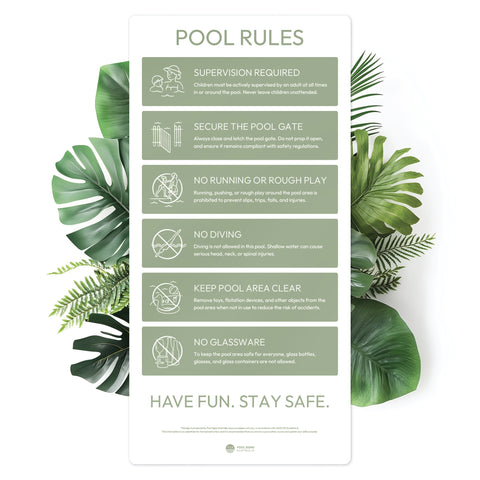
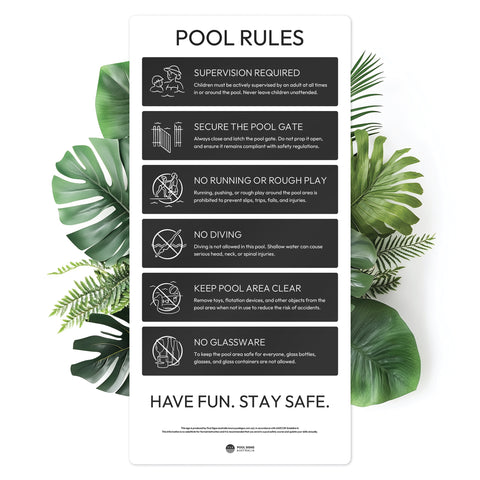
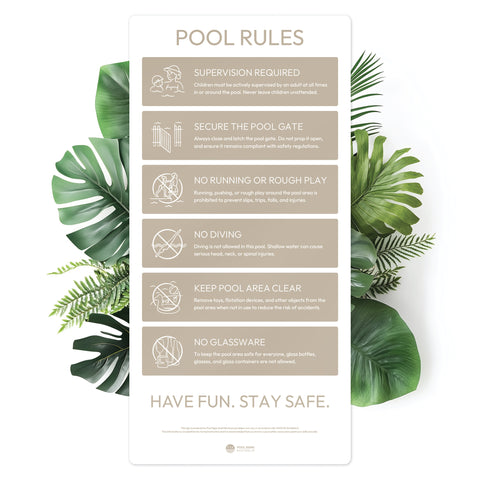
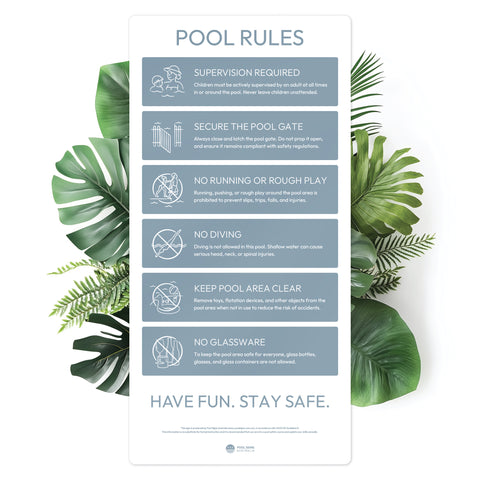
Common rules displayed on pool rule signs include:
- No running on pool decks
- No diving in shallow water
- Children must be supervised at all times
- No glass in the pool area
- No rough play or pushing
- Keep gates closed after entering or leaving
These rules address the most common risks associated with pool use.
Clear Communication Matters
Effective signage uses concise language and, where possible, visual symbols that can be understood quickly. This is especially useful in environments where visitors may not be familiar with the facility.
Good pool rule signs should be:
- Easy to read from a distance
- Displayed in clear, high contrast colours
- Designed with simple layouts
- Installed where users naturally see them
By presenting information clearly, pool rule signs reinforce safe behaviour without requiring constant supervision.
Complementing Other Safety Signs
Pool rule signs work alongside other types of pool safety sign Australia requirements.
A well managed pool area may include:
- CPR resuscitation charts
- Emergency contact instructions
- Hazard warnings
- Behavioural rule signage
Together, these signs create a complete safety communication system.
Accident prevention studies consistently show that visible safety messaging reduces risky behaviour in public and shared spaces. When rules are clearly communicated, people are more likely to follow them.
Aquatic facility management guidelines across Australia recommend displaying behavioural rules near pool entrances and deck areas. These guidelines are widely adopted by hotels, apartment complexes and recreational centres.
Pool safety inspectors and risk auditors also consider signage when assessing the overall safety management of a facility. Clear rules demonstrate that pool operators are actively communicating expectations and taking reasonable steps to prevent accidents.
From a liability perspective, visible rule signage can also help show that appropriate warnings were provided to users.
Installing effective pool rule signage is a straightforward process.
Step 1: Identify common safety risks
Consider behaviours that could cause accidents in your pool area.
Step 2: Select relevant rules
Choose clear messages that address these risks.
Step 3: Choose durable signage
Use materials suitable for outdoor environments, such as UV resistant and waterproof signs.
Step 4: Install at visible locations
Place pool rule signs near entrances, gates or high traffic areas.
Step 5: Ensure readability
Check that text size and contrast make the sign easy to read.
Step 6: Inspect regularly
Replace signs that become faded or damaged.
Step 7: Review periodically
Update signage if facility rules or safety policies change.
This process helps ensure your signage remains clear, effective and professional.
Across Australia, pool safety standards vary slightly by state, but the emphasis on clear communication is consistent. Residential pool owners often install basic rule signage to guide guests and visitors. Shared facilities such as apartment complexes, holiday rentals and hotels rely even more heavily on visible safety instructions.
In these environments, many people use the pool who may not be familiar with the rules or layout of the space. Pool rule signs provide immediate guidance that supports safer behaviour.
Australia’s outdoor climate also places high demands on signage durability. Strong sunlight, heat and moisture can quickly degrade low quality materials. Using professional grade signage designed for Australian conditions helps maintain readability and long term effectiveness.